Representatives from politics and administration, as well as from aid organisations and associations, came together on 3 November 2025 for an intensive exchange at Koblenz University of Applied Sciences in Remagen. Participants included Caritasverband e.V., Die Vereinsagenten e.V., the Bad Neuenahr-Ahrweiler municipal administration and the Deputy Victims' Commissioner of the Rhineland-Palatinate state government.
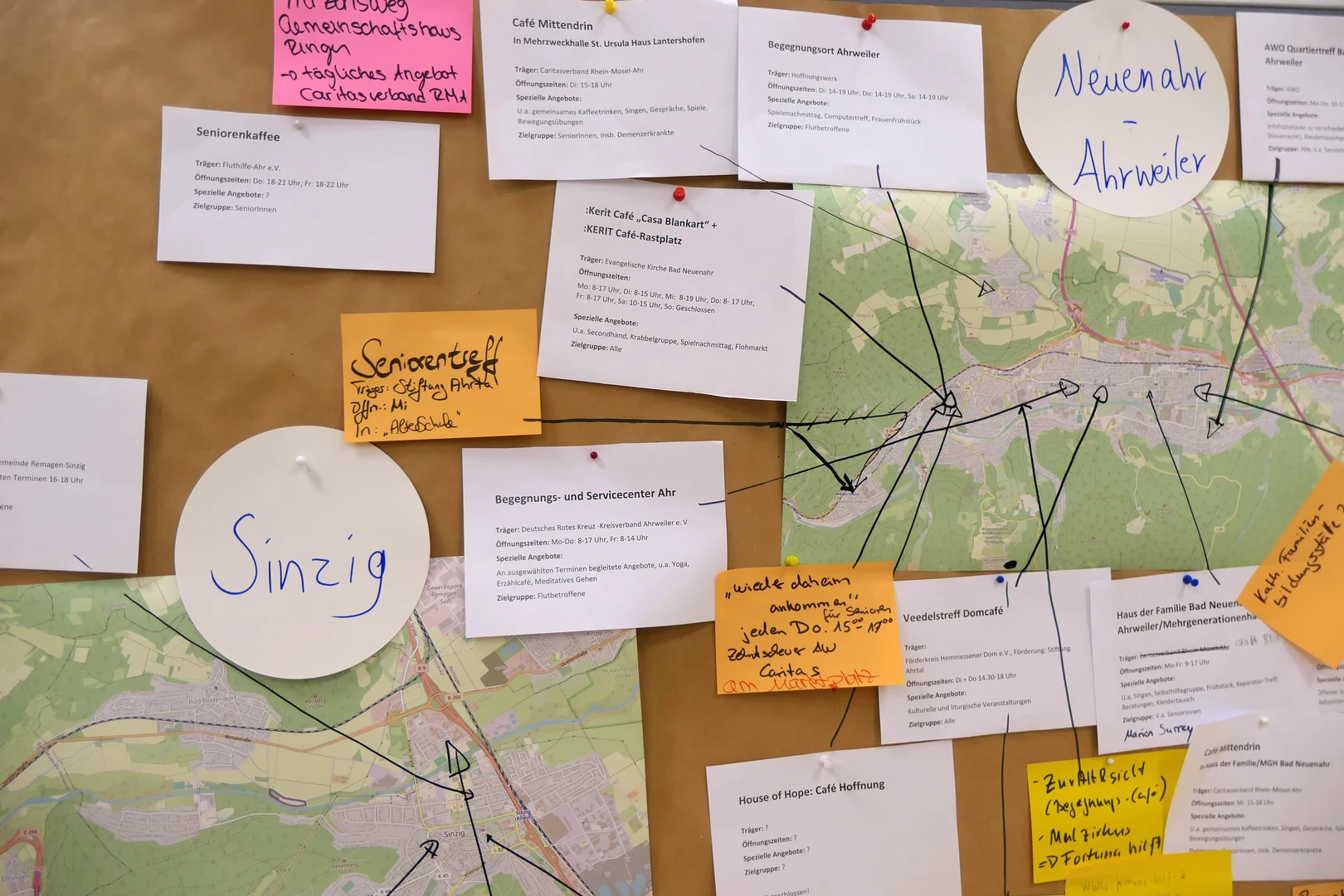
In the first part of the workshop, a gallery walk was used to take stock of the meeting places in the Ahr Valley. The participants collected an initial overview of existing facilities on display boards. A total of 43 meeting places from Sinzig to Ahrdorf were identified, and initial trends in terms of the distribution of locations, sponsors and target groups were observed.
There appears to be a concentration of meeting places in the urban area of Bad Neuenahr-Ahrweiler, while significantly fewer facilities were noted in the municipality of Adenau. According to the participants, there are mainly informal initiatives there that are run by volunteers. In addition, most of the services listed in the overview are aimed at all generations, some specifically at senior citizens and only very few specifically at children and young people. A structured survey of all identified meeting places is intended to provide reliable figures on specific services, volunteers and support needs. By distributing the survey widely within the SOZIAHR practice network, the aim is also to include additional, previously undiscovered meeting places in the overview.
On additional display boards, participants were asked to provide feedback on an excerpt from a questionnaire from a SOZIAHR population survey. Another topic discussed was the continuing role of the meeting places in the wake of the floods – in particular as a place for sharing experiences, as a point of contact in bad weather, and for providing expert advice in the context of reconstruction. A vision board also gave rise to the idea of setting up a digital pilot system for meeting places in the Ahr Valley. The SOZIAHR survey could provide a valuable database for this purpose.
The second part of the workshop aimed to analyse the current challenges facing meeting places in greater depth and to gather ideas on how their situation could be improved in the future.
The focus was on three topics, which the participants discussed in smaller working groups:
- Exchange of experiences and best practices in daily work
- Delineation of tasks and areas of responsibility & cooperation
- Structural support for meeting places
Based on the ideas gathered in the working groups, six key objectives for promoting meeting places in the Ahr Valley were formulated:
- Long-term and secure financing models through public authorities
- Business partnerships (e.g. premises, promotion of voluntary work)
- Supervision and psychosocial counselling for volunteers
- Quality assurance through training, evaluations and certificates of good conduct
- Clear delineation of the tasks and areas of responsibility of meeting places
- Cross-institutional cooperation
We would like to thank all participants who contributed to the approximately three-and-a-half-hour workshop on providing social science support for the reconstruction in the Ahr Valley.
The event was organised by the ‘SOZIAHR’ research project at the University of Bonn, with the kind support of the ‘Science for Reconstruction’ (WfdW) competence network and the Zukunftsregion Ahr e.V. association.
This press release was taken from www.soziahr.uni-bonn.de.