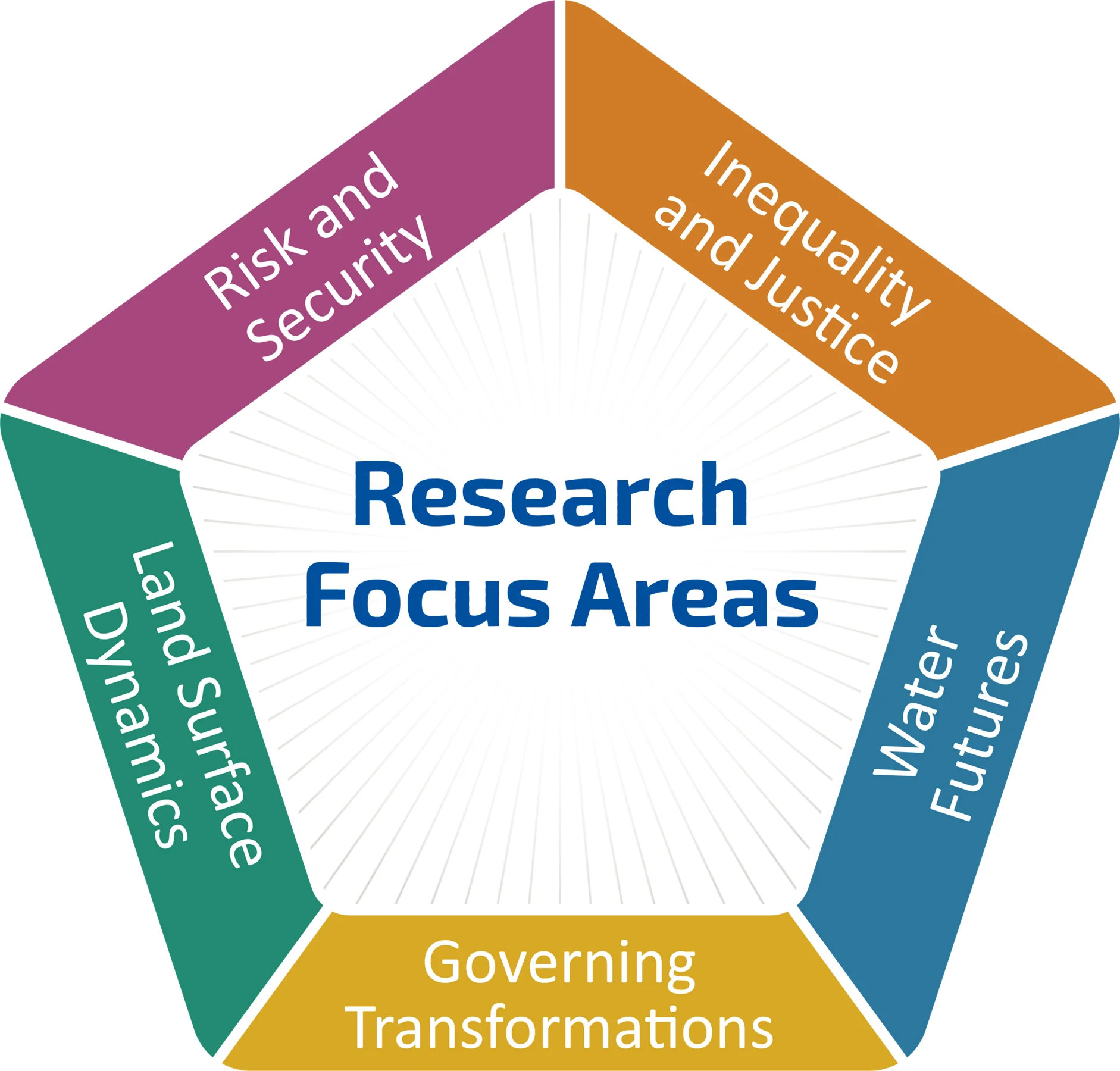
Research Focus Areas
The department’s research focus areas, which overlap with and complement one another in terms of their content, are reflected primarily in its research projects but also in its teaching. They pool the department’s expertise and that of the individual working groups. The topics addressed by the key fields cover a wide range of cross-disciplinary research questions that can only be tackled adequately through inter- and transdisciplinary dialogue. For this reason, they focus on building up an academic network within the department and collaborations within the University of Bonn’s Transdisciplinary Research Areas as well as with other institutes and researchers at the University of Bonn, the Geoverbund ABC/J and with research partners in Germany and further afield.
The scientists at the GIUB conduct joint research across working groups in projects relating to the department's research focus areas. These address key global challenges facing human societies and the Earth system. They lie at the intersection of physical geography and human geography and are addressed through intradisciplinary collaboration.
- Water Futures
- Risk and Security
- Governing Transformations
- Inequality and Justice
- Land Surface Dynamics
Water Futures
Global change leads to radical shifts in the water cycle and increasing anthropogenic pressure on water systems, which are key drivers of the research focus Water Futures. At its core are questions on how hydrological systems function, how we observe processes and change, which magnitudes are reached by extreme events and how to build better models for predicting catchment function and change. Furthermore, our research aims at identifying and implementing solutions for a sustainable science-based management of water resources in terms of water quantity and quality.
We address these challenges through multi-method approaches building on ground-based observation and experimentation, remote sensing, application of natural and artificial tracers, analysis of field evidence and historical sources, and modelling approaches. Implementing managing options are further studied through participative methods with stakeholders. The Water Futures research addresses water-related questions across the globe with a key focus on Africa, the Americas, Asia and Europe.
The research focus Water Futures contributes to the University of Bonn’s Transdisciplinary Research Areas TRA Mathematics, Modelling and Simulation of Complex Systems (TRA1) as well as to Innovation and Technology for Sustainable Futures (TRA6).
The research focus on Risk and Security is concerned with holistic approaches to risk, interrelated facets of security and critical interrogations of the politics and geographies of (in)security and securitisation. It explores the interplay of hazards, vulnerabilities and exposures in different geographical and socio-cultural contexts as well as the uneven landscapes and experiences of (in)security that result from unequal global-local relations of power. Research in this focus area deals with concepts and solution-orientated aspects of disaster risk reduction, water security, and human security using a sound and complementary mix of quantitative and qualitative methods.
In a world of increasing cascading and systemic risks, aspects of prevention and adapting human security are of particular importance in this challenging and dynamic research focus and are therefore an integral part of our Master's programmes. The research focus also develops critical perspectives on security discourses and policies, considering how the latter impact on and intersect with the experiences and agencies of everyday actors in diverse contexts.
Current research is focusing, for example, on floods (magnitudes, recurrence intervals, designation of floodplains, management strategies), droughts, landslides or permafrost degradation, as well as on social requirements for risk management in spatial planning, associated health risks and pandemics or food security issues. Further topics include migration, militarisation, emotional geographies of security and insecurity, and violence. The research focus Risk and Security contributes to the Transdisciplinary Research Areas Sustainable Futures (TRA6) and Individuals, Institutions and Societies (TRA4) of the University of Bonn.
Governing Transformations
The research focus Governing Transformations addresses societal changes and social-ecological transformations, and their significance for sustainable development in a globalized world. At its core are questions of how economic, social and ecological transformations are, and can be, shaped and managed, e.g. with respect to energy and water systems, housing and financial markets, industrial and urban development, climate change adaptation and mitigation. Our research explores both radical and gradual approaches to transformation, ranging from technological advancements, economic incentives, state regulations and public policies, to civil society initiatives and shifts in geographical educational. Particular emphasis is placed on actors and institutions, and thus the governance constellations and mechanisms, in transformative processes. By drawing on diverse approaches from all over geography as well as from various neighboring disciplines, including, e.g., social and political sciences, cultural and media studies, anthropology and economics, theoretical perspectives are critically examined to develop a more comprehensive understanding of the challenges and opportunities inherent in different types of transformation. The research focus Governing transformations contributes to the University of Bonn’s Transdisciplinary Research Areas Individuals and Societies (TRA4) as well as to Sustainable Futures (TRA6).
Inequality and Justice
The research area on Inequality and Justice covers topics related to societies, settlements, institutions and policies through an exploration of inequitable power, wealth and entitlements using lenses of social, climate and gender justice and political ecology, feminist and critical theories. The work looks at societies in the Global North and the Global South, critically examining social, economic and environmental dimensions that structure inequalities and injustices, and solutions to address these. We explore community/local scales up to spaces of global policy making, for example on climate change and biodiversity. Themes addressed include the drivers of vulnerability to climate change and the politics of adaptation and maladaptation, water and energy access as a source of political conflict and cooperation, and epistemic hierarchies in research and policymaking. Additional topics include precarity in housing, the legacy of colonialism in environment-development governance, identity and citizenship, and justice and (in)security and violence.
Methodologies applied include a wide array of qualitative approaches situated in the field, including in Germany and Europe as well as across Asia, Latin America and Africa.
This research contributes to the University of Bonn’s Transdisciplinary Research Areas Individuals and Societies (TRA4), Present Pasts (TRA5) and the Bonn Centre for Dependency and Slavery Studies (BCDSS).
Land Surface Dynamics
The research focus on Land Surface Dynamics examines the characteristics of interactions between landforms, Earth surface processes, water systems, geological and biological cycles, landuse, and climate. We study and model past, recent, and future land surface dynamics in changing spatiotemporal patterns and Earth system responses to climatic and land cover/use change forcing. Examples of key research questions investigated across different spatial and temporal scales include how landscapes evolve over time under the changing climate; how water and sediment fluxes can be modelled in relation to management of water resources; or how climate change affects the main cycles of terrestrial ecosystems (i.e., carbon and water cycles, and energy balance).
This interdisciplinary research focus comprises a variety of scientific methods and techniques such as multiscale field experiments and measurements, quantitative lab analysis, air-/space-borne remote sensing, and statistical as well as numerical modelling.
Under this focus, our research examines, inter alia, dynamics of landslides and mountain permafrost, remote sensing vegetation stress detection and reactions using radiative transfer models, land surface modelling including biogeochemical cycles, watershed modelling, sediment mobilisation, evolution of alpine ecosystem, and more. Other teams are investigating geomorphological and anthropogenic evidence from recent, historic and pre-historic floods to droughts for their quantitative reconstruction. The research focus Land Surface Dynamics contributes to the Transdisciplinary Research Areas Modelling (TRA1) and Sustainable Futures (TRA6), Center for Earth System Observation and Computational Analysis (CESOC), but also to the PhenoRob Cluster of Excellence of the University of Bonn.