

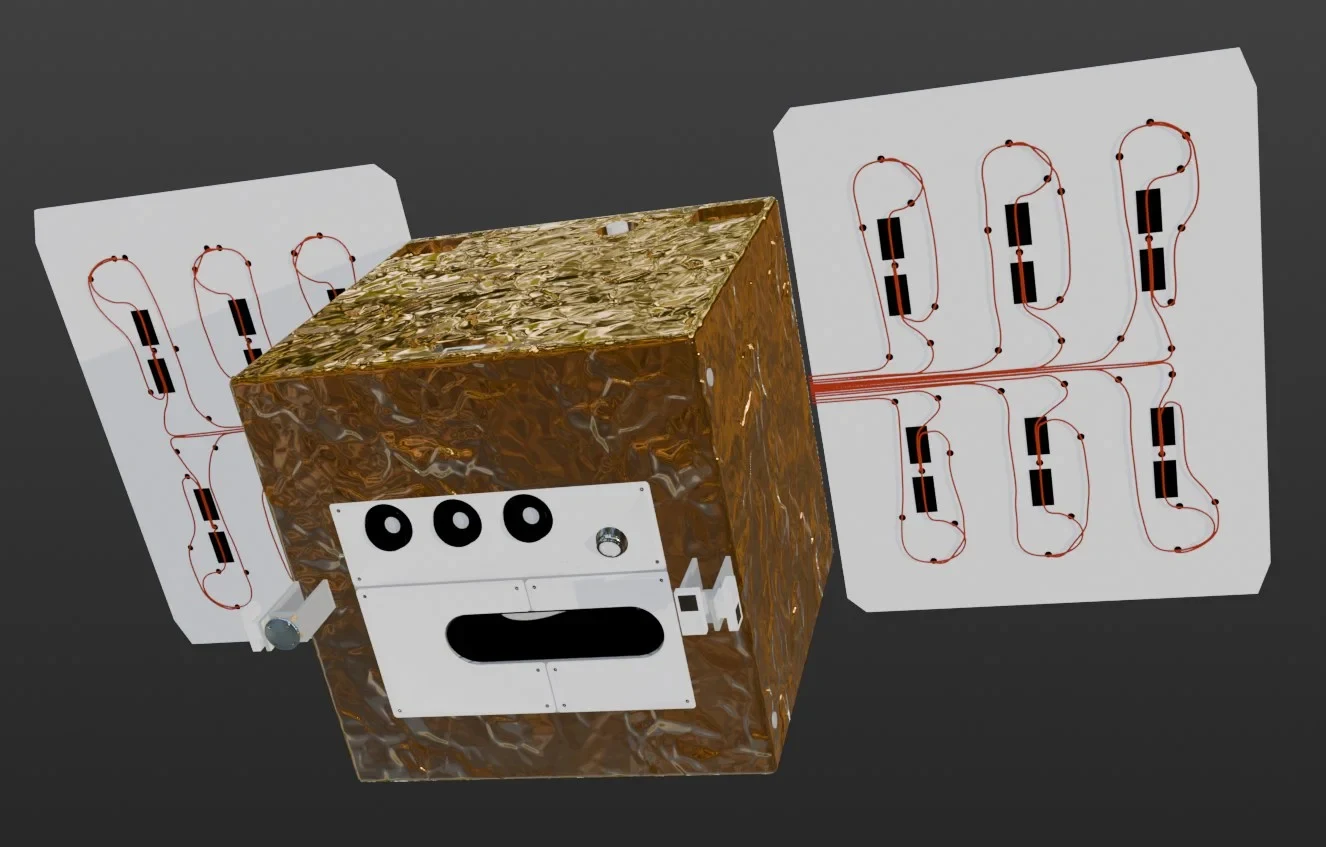
The “DIEGOSat” satellite will enable a nearly continuous flow of data originating from up to three daily overflights over Germany. This opens up new opportunities, for example, for precise monitoring of vegetation, drought or water requirements in agriculture, as well as early detection and analysis of wildfires. In addition, the project makes a significant contribution to climate protection by providing early-warning data reducing drought and crop failures, enabling targeted adaptation strategies to climate change, and closing existing gaps in important Earth observations. Applications range from environmental monitoring, security and disaster prevention to weather forecasting, irrigation of plants, urban planning, and health.
Examples of the wide range of applications include the detection and mapping of forest fires, droughts, crop and forest stress, and heat islands in large cities. “In contrast to other Earth observation satellites, DIEGOSat will not fly over the Earth poles, but will be placed on an inclined equatorial, sun-asynchronous, west-east orbit,” says Prof. Dr. Zbyněk Malenovský from the Remote Sensing Research Group at the Institute of Geography at the University of Bonn. “Such satellite development projects are not often carried out by German universities. This offers the universities in Bonn and Bochum the unique opportunity to make a contribution to space-based Earth observing.”
Bonn simulations help to optimize the satellite sensor
The Remote Sensing Research Group at the University of Bonn is working on a physically-based model called “DART” (Discrete Anisotropic Radiative Transfer), which is being developed and maintained by colleagues at the CESBIO laboratory in France. “Since DART’s aim is to simulate optical satellite images, we will further develop its ability to simulate the future DIEGOSat image data,” says Malenovský. “These virtual computer simulations will help us to optimize technical specifications of the satellite sensor for a variety of applications.”
Feasibility study as an important milestone
The feasibility study that has now begun is an important first milestone in the realization of the overall project. It includes a precise definition of the project objectives, the cost framework, the technical requirements, and the planned data products. Particular attention is being paid to close cooperation with potential users from industry, administration, and science, especially within North Rhine-Westphalia.
Requirements will be systematically recorded and prioritized in collaboration with the German Aerospace Center (DLR). With funding of about 300,000 euros, the feasibility study is being fully financed by the Ministry of Economic Affairs and Climate Protection of NRW. If the study is successful, there is the possibility of federal funding for the construction of the satellite, and the establishment of a control and data processing centres in North Rhine-Westphalia. This would significantly strengthen the state's space sector and further consolidate its position as a national and international location for civil Earth observation.
Innovations from North Rhine-Westphalia
Mona Neubaur, Minister for Economic Affairs, Industry, Climate Protection, and Energy of the State of North Rhine-Westphalia says: "Whether it's the climate crisis, droughts in summer, or growing demands on our agriculture, we need accurate, up-to-date data to be able to respond in a targeted and timely manner. This is exactly where DIEGOSat comes in: the satellite can help us identify environmental changes more quickly, identify risks at an early stage, and thus better protect lives, crops, and infrastructure. At the same time, this project strengthens research, creates new opportunities for our high-tech economy, and shows what is possible when science, industry, and politics work together. With DIEGOSat, North Rhine-Westphalia is proving that innovations from North Rhine-Westphalia can have a global impact – for the benefit of people and the environment."
This article dated July 31, 2025, was taken from the website of the University of Bonn, available at https://www.uni-bonn.de/de/neues/innovative-erdbeobachtung-mit-diegosat-fuer-klimaschutz-landwirtschaft-und-sicherheit