

This paper presents Holocene sediment cascades in the German Limestone Alps, considering both spatial and temporal perspectives. It provides insights into the dynamics and understanding of sediment cascades in alpine landscapes. Altitude-dependent geomorphological processes (e.g. rockfalls, debris flows, avalanches, etc.) are controlled primarily by climate, topography, lithology, and glacial heritage, and form so-called sediment cascades. The effectiveness of sediment transport through a system over time depends on the connectivity and coupling of geomorphological processes. Different sedimentary catchments in the Wetterstein and Berchtesgaden Alps are highlighted and discussed, especially regarding variable geological and lithological conditions and corresponding patterns of dominant geomorphological process domains. The Reintal Valley in the Wetterstein mountains is presented as one of the best studied catchments in terms of sediment cascades. It is controlled by a series of large-scale rockfall deposits and moraines that trap significant amounts of sediment in the valley. The Königssee, Wimbach and Klausbach valleys in the Berchtesgaden National Park are then introduced. They serve as textbook sites to illustrate adjacent but strongly contrasting sediment transport systems.
New Publication by Götz & Schrott 2025 New Publication by Götz & Schrott 2025
"Holocene Sediment Cascades in the German Alps" by Götz & Schrott 2025, published in Lehmkuhl, F., Böse, M. & Krautblatter, M. (Hrsg.): Landscapes and Landforms of Germany. (Springer Nature Switzerland) Cham. S. 475-491. doi: https://doi.org/10.1007/978-3-031-77876-6_28
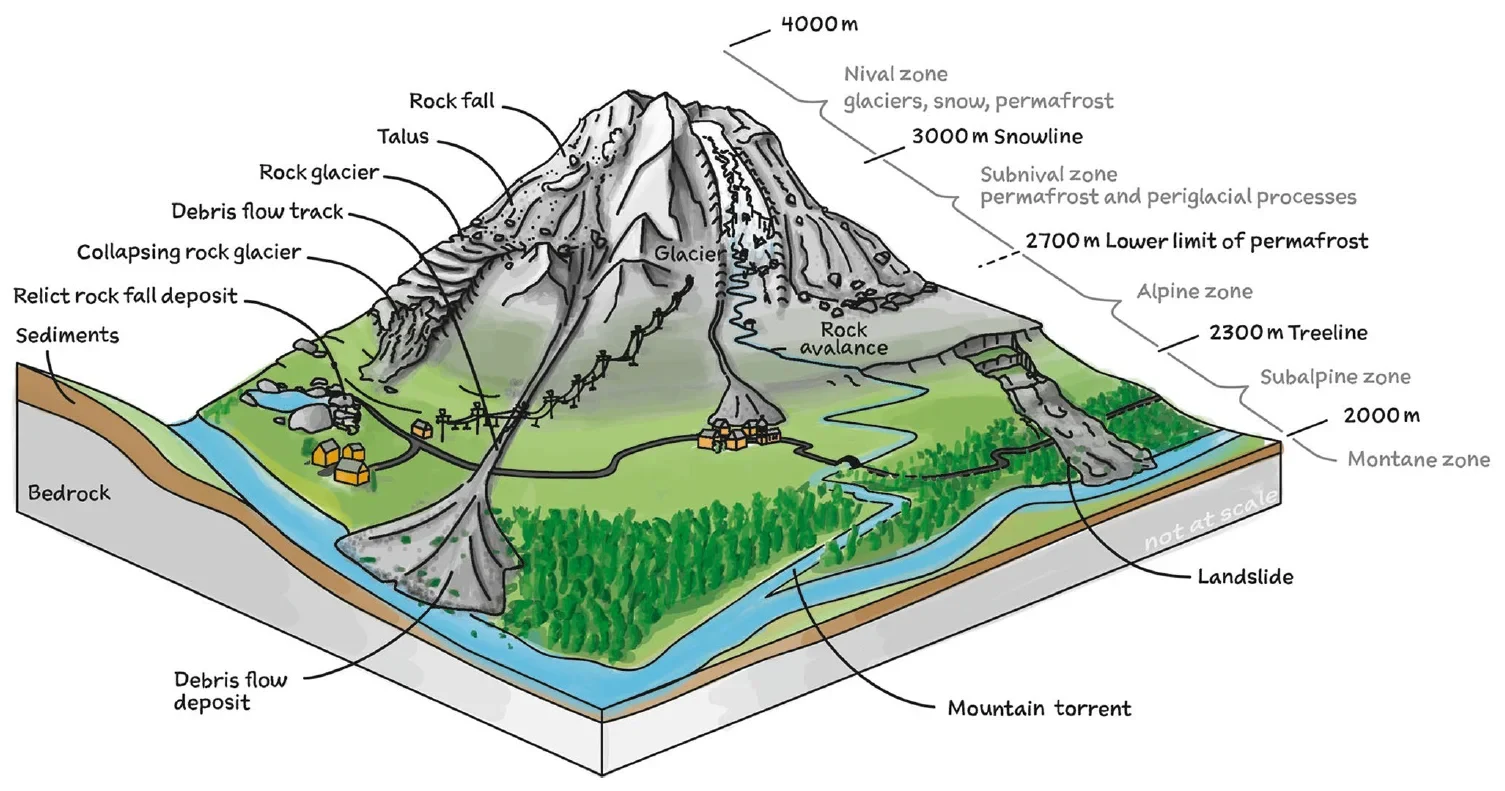
Fig. 6.3.1 Schematic block diagram showing elevation-dependent cascading processes and related landforms exemplified for the European Alps. Please note that the nival zone with permanent snow and ice is almost absent in the German Alps. Only four small glacier remnants are left (Nördlicher Schneeferner, Höllentalferner, Blaueisgletscher and Watzmanngletscher). Sporadic mountain permafrost is present at the highest north-exposed rockfaces near the summit of Zugspitze in the Bavarian Alps south of Garmisch-Partenkirchen (2960 m asl) (see also Chap. 6.2, Hagg and Krautblatter 2025). Snowline, lower limit of permafrost and treeline vary from West to East, North to South and from peripheral to central locations within the Alps. Thus, altitudes indicate only average values (conception: L. Schrott; cartography: I. Johannsen)
© Götz & Schrott 2025
Alle Bilder in Originalgröße herunterladen
Der Abdruck im Zusammenhang mit der Nachricht ist kostenlos, dabei ist der angegebene Bildautor zu nennen.
For more publications of the Geomorphology and Environmental Research Group please go to our research section.