

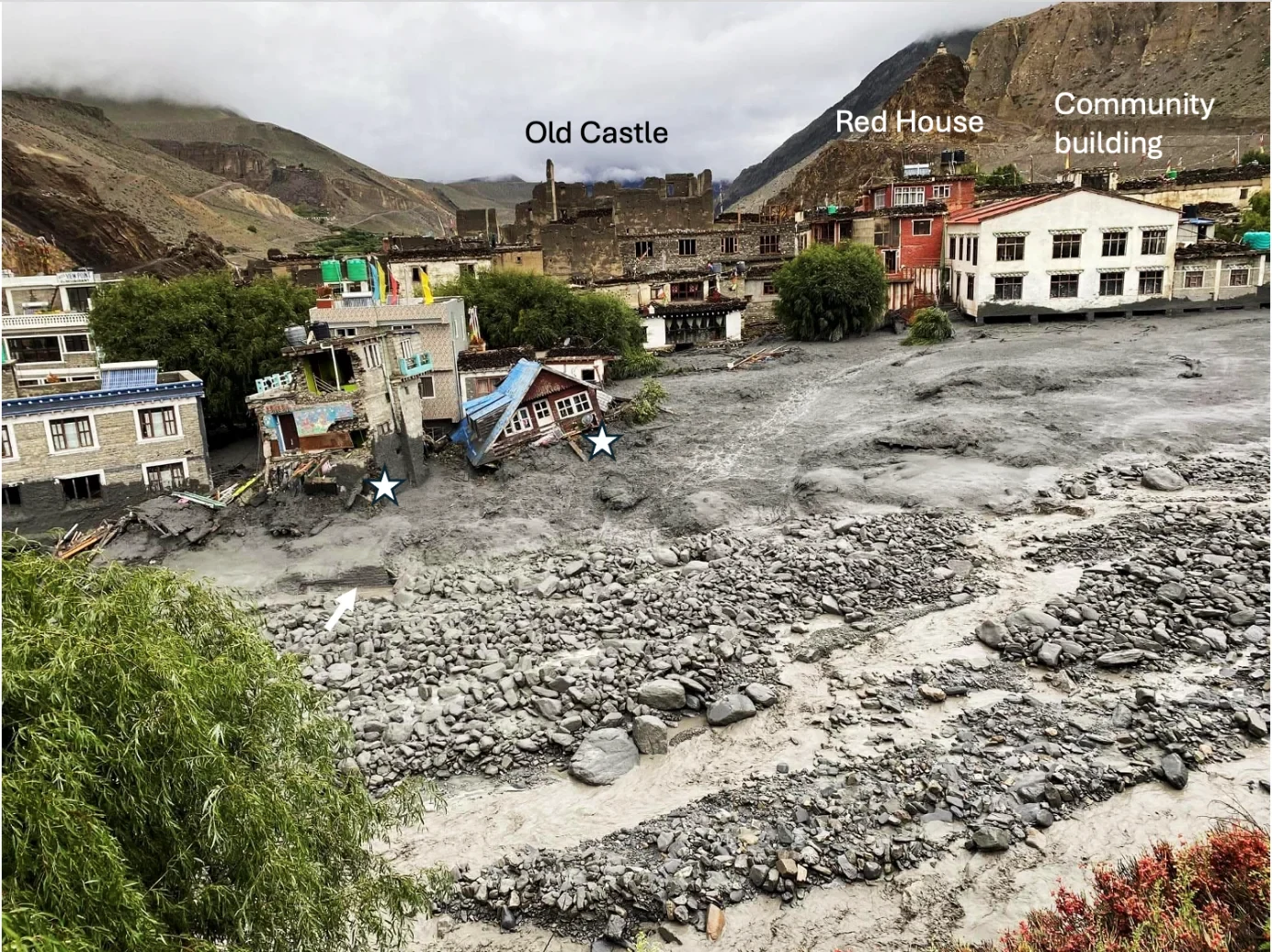
Located in the northern, rain-shadow zone (< 300 mm/yr) of the Nepal Himalaya, Kagbeni village (2810 m, 420 inhabitants, at the junction between Jhong Khola and Kali Gandaki) was affected by a disastrous, unusual hyper-concentrated flood on August 13, 2023. It caused significant damage to property and infrastructure (cost estimated at USD 7.4 millions), fortunately without fatalities.
For several years, increased rainfall has been recorded at Jomsom station (2720 m), a trend confirmed by residents. However, no single extreme rainfall event that could have triggered the flood was recorded at Jomsom station or in CHIRPS rainfall data for the Jhong Khola valley. Considering the geomorphological context, we hypothesized that the flood event was most likely triggered by a landslide-lake outburst. The landslide existence and source area (upstream from Chhiongur gorges) were confirmed by analysis of Sentinel-1 InSAR coherence time series. Downstream, the flood spread over the entire valley floor, as evidenced by new deposits, bank cuttings and reactivation of landslides providing additional debris and making downstream flooding even more destructive (bridges, buildings, livestock, orchards...). The volume of debris transported was estimated at 647,000 m3, followed by rapid post-flood re-incision (215,000 m3).
The inhabitants of Kagbeni also contributed to disasters by settling on very low terraces and encroaching on the Jhong Khola riverbed. Upstream of the village, the Upper Mustang Road bridge also amplified the damage through a bottleneck effect: its concrete deck collapsed, and its transport was very destructive downstream.
Given the general trend towards climate change, the probability of future, similar flash floods remains high in Kagbeni, yet some residents have rebuilt their homes and continue to live on hazardous floodplains. We suggest some measures for preventing future risks, such as (i) applying the Freedom Space for Rivers concept to avoid encroachment of floodplains by anthropogenic activities, and (ii) managing a concrete ford-type structure instead of poorly calibrated bridge deck along the Upper Mustang Road. More generally, a nationwide natural risk-reduction policy should be implemented.